
THE INTERCONNECTION GAUNTLET
410 GW, No Standards, and the Framework That Has to Replace Them

Part 2 of two. Based on the ESIG Large Loads Task Force report “Interconnection Processes for Large Loads: Current Practices and Recommendations” (June 2026).
Gilles Chaspierre is the author of “Grid Stability in the Era of Inverter-Dominated Power Systems” and the founder of GridStab News. He has worked with major TSOs including RTE, AusNet, and Elia on grid stability, EMT simulation, and grid-forming converter deployment. Get the book
Subscribe to GridStab News for weekly insights on power system stability, grid-forming technology, and the operational challenges of the energy transition.
1. The Question Part 1 Left Open
In the first part of this series, When Data Centers Shake the Grid, we catalogued what the ESIG Large Loads Task Force has documented: 1,500 MW of Northern Virginia data center demand transferring to backup power during a normally cleared fault; a 23 Hz oscillation injected into the ERCOT system by a single facility; a 14.7 Hz limit cycle traced to UPS controller saturation in Dominion Energy’s territory; and simulation models that, when applied to these facilities, show a well-behaved load where a detailed EMT representation reveals sustained instability.
Each of those failures was, in principle, catchable. A study with the right load model and the right simulation domain would have revealed the UPS–series-capacitor interaction. A protection review during the connection process would have flagged the dip-counting logic that tripped an 80 MW data center during a routine reclose. A binding ride-through obligation would have made the Northern Virginia transfer a design fault rather than an operational surprise.
None of that happened, and the reason is institutional rather than technical. These facilities connected through an interconnection process that was designed for a different kind of load, that mandates no dynamic models, that requires no EMT screening, that imposes no ride-through obligation, and that — in most of the United States — subjects a 1 GW data center to less reliability scrutiny than a 20 MW wind farm. This article is about that process: what it is, why it is failing, and what has to replace it.
2. The Scale of the Problem
The numbers alone tell the story. As of March 2026, ERCOT’s large load interconnection queue contained over 410 GW of new load from 551 applications, of which 88% were data centers. For context, ERCOT’s all-time record peak demand is 85.5 GW, set in 2023. Nationally, Cleanview estimated in February 2026 that more than 650 planned data center projects would add over 176 GW of peak demand. MISO has more than 13 GW in its own queue. The U.S. Department of Energy estimates that national electricity demand is likely to grow by 15–20% over the next decade, and could double by 2050 under certain scenarios — a reversal of a long period of flat or declining demand.
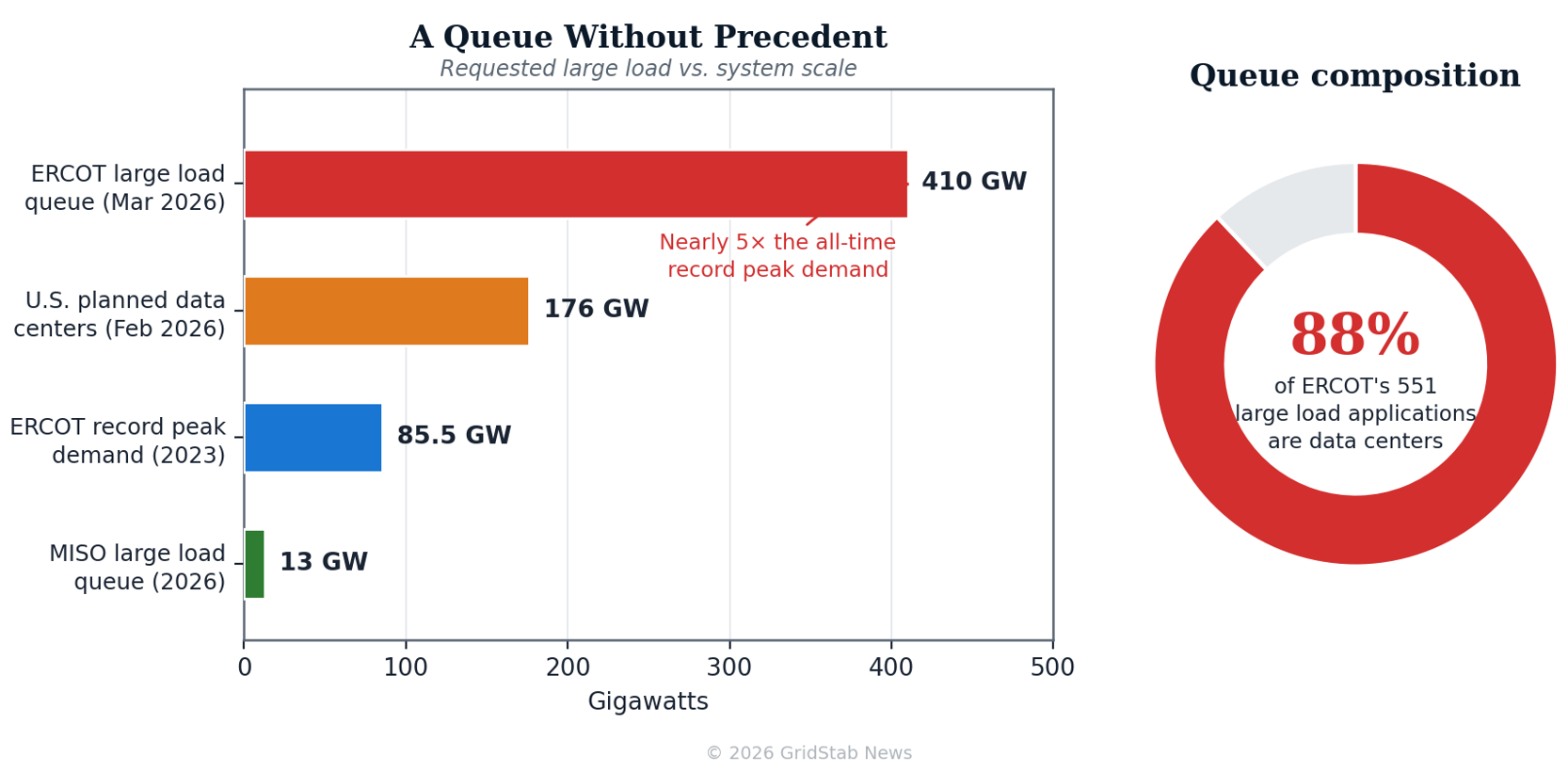
Figure 1. The requested large load in ERCOT’s queue is nearly five times the system’s all-time record peak demand. Many of these projects will never be built — but the queue itself consumes engineering resources and distorts the load forecasts that drive transmission planning. Data from ERCOT (2026), Cleanview (2026), MISO (2026).
Not all of this load will materialise. Bulk power system construction times, high interconnection costs, speculative queue entries, supply chain constraints, and shifts in chip technology will thin the field considerably. But even a modest fraction represents a structural change in how the electric power system must plan for demand.
The deeper problem is a timeline mismatch that no amount of process streamlining can fully resolve. A new data center can be planned, permitted, and built in two to three years. Transmission infrastructure takes seven years for planning and permitting alone, with another three for construction. Synchronous generation falls somewhere in between. Large loads therefore arrive at the grid’s doorstep long before the system that must serve them can be expanded.
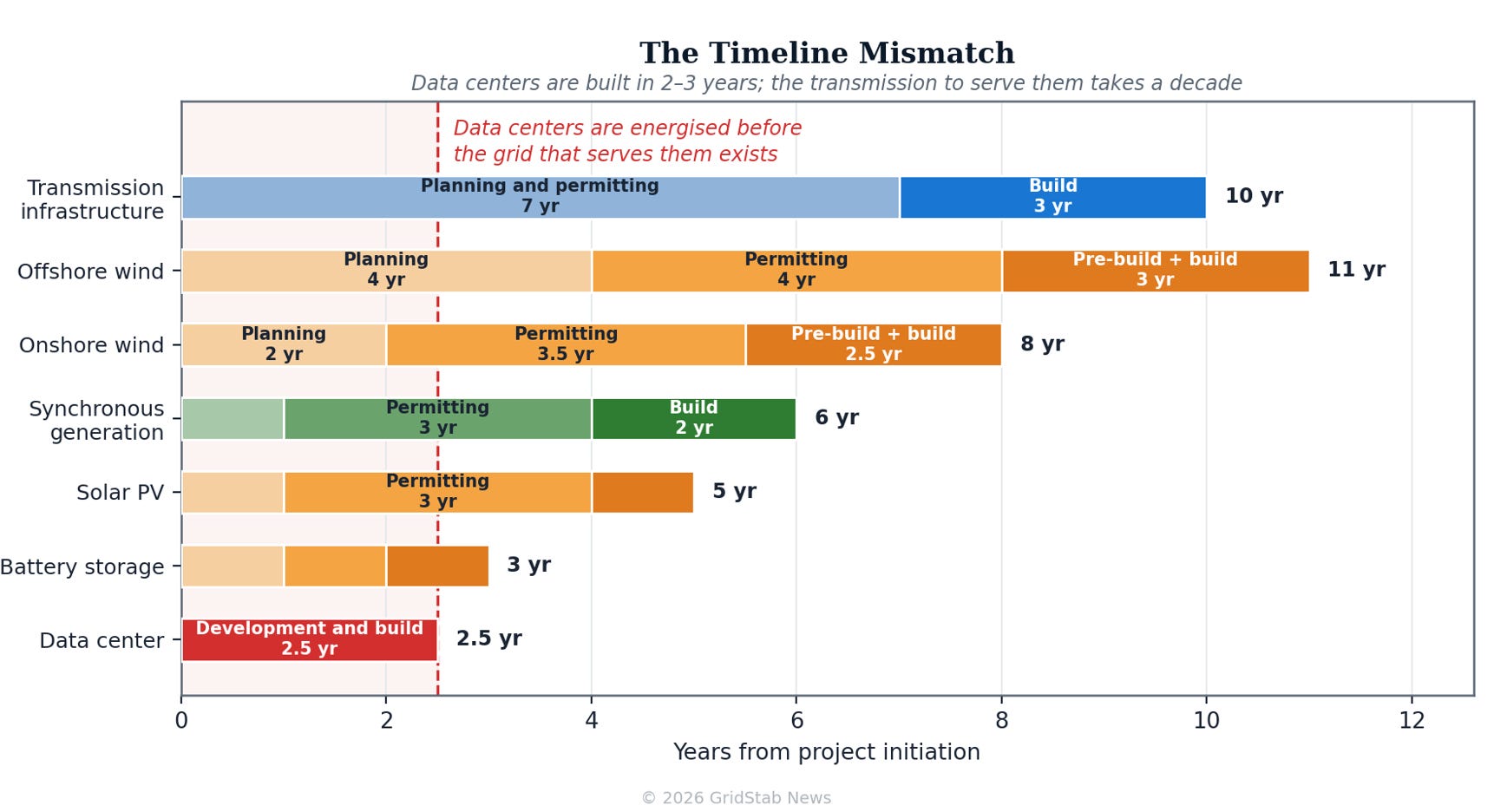
Figure 2. The timeline mismatch. Data centers are energised on a two-to-three-year cycle; the transmission that serves them takes a decade. This asymmetry is the structural driver behind queue congestion, interim service arrangements, and the pressure on operators to connect load faster than they can reliably study it. Adapted from Quint et al. (2025), as presented in ESIG (2026).
—— YOU ARE 30% INTO THIS ARTICLE ——
What follows behind the paywall:
So far, you’ve seen the scale: over 410 GW of large load requests in ERCOT alone, against a record peak of 85.5 GW, arriving four times faster than the grid can be built to serve it. But scale is not the reason data centers are tripping during routine faults. The remaining 70% of this article covers:
Processes built for a different load — why interconnection procedures designed for 50 MW factories cannot handle GW-scale power-electronic facilities, and how the coordination gap between utilities and ISOs/RTOs leaves regional operators blind until it is too late (Section 3).
The standards vacuum — load facilities are not NERC-registered entities and therefore have no applicable reliability standards, even as a single 1 GW data center outweighs a 20 MW wind plant in system impact. How NERC’s Level 2 and Level 3 alerts escalated in response (Section 4).
Where the studies fail inside the process — the missing model submission milestone, the absence of mandated EMT screening, and a milestone-by-milestone map of exactly where Part 1’s failures originate (Section 5, with process diagram).
A fragmented global landscape — a jurisdiction-by-requirement matrix comparing ERCOT, SPP, NYISO, PJM, MISO, CAISO, EirGrid, the EU Demand Connection Code, and NERC/FERC across nine technical requirements (Section 6).
Four imperatives for the framework that has to replace it — and why the endpoint is not compliance but contribution: data centers as providers of ride-through, dynamic reactive power, and grid-forming stability margin (Sections 7–8).
Subscribe to GridStab News to unlock the full article and all future technical deep dives.
